


‘East of Eden’: Four key differences between John Steinbeck’s novel and the Netflix series
Netflix’s collection of book-to-screen adaptations has found the ultimate candidate to hook fans: East of Eden, based on John Steinbeck’s 1952 magnum opus, the epic intergenerational family saga of the Trask and Hamilton families.
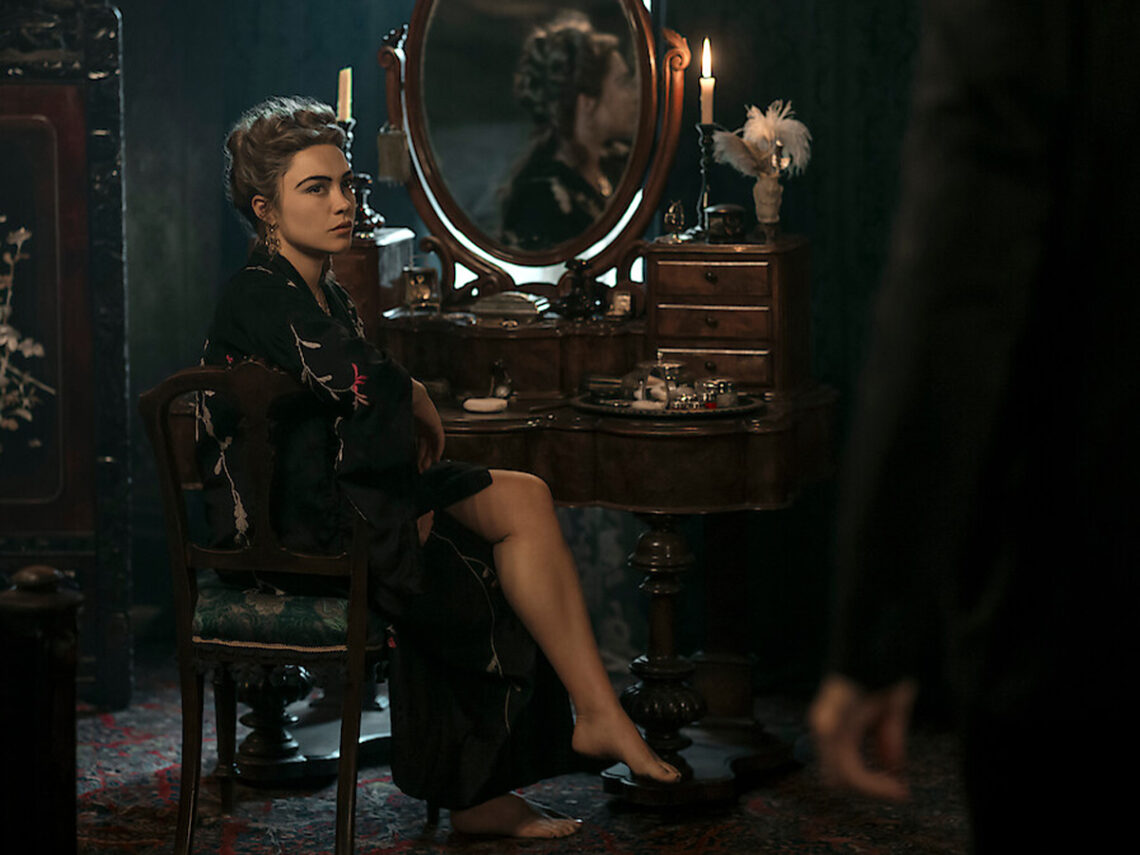
At the heart of the Netflix limited series, which aims to capture the world that’s built across more than six hundred pages, is the controversial, indelible antihero Cathy Ames, portrayed by Florence Pugh. Zoe Kazan has adapted the seven-episode series for modern viewers, openly embracing changes that make the story seem familiar yet different.
While the series is undeniably rooted in the original text, Kazan took the liberty to explore some character arcs more deeply than others, offering a perspective that’s unique and liberating on its own.
Although fans have already noticed differences in Cathy’s portrayal in the novel and the series, here are four more differences between Steinbeck’s novel and East of Eden on Netflix.
Four differences between John Steinbeck’s book and East of Eden on Netflix
The evolution of Cathy Ames
The most on-the-nose difference between the East of Eden series and John Steinbeck’s novel is Netflix’s treatment of Cathy Ames, originally portrayed as a symbol of evil in the book, infamous for manipulating and ruining the lives around her. Although the series doesn’t do away with her actions that set the story in motion in the first place, it changes how viewers perceive them by explaining where they come from.
The 1952 novel details enough to help readers connect the dots of Cathy’s history. However, Zoe Kazan makes that understanding a crucial part of the Netflix adaptation.
Steinbeck’s Cathy embodies the biblical concept of original sin, making her one of the most divisive antagonists of American literature. Yet, the Netflix series tries to reason with Cathy’s actions, delving deep into her character through episodes to question whether her deeds or misdeeds were born out of a vacuum or through her scarring survival in a misogynistic, violent era where being a woman and having any sort of agency itself was a sin.
In a conversation with Vulture, Florence Pugh said, “[Zoe] didn’t want to berate [Cathy].” “We were aware that we were going to have to do so much thinking to make this person watchable, and that was a beautiful ode to this woman in that era who wasn’t really given much forgiveness.”
The Hamiltons arc
John Steinbeck’s literary work focuses on two entwined families: the Irish-American Hamiltons who are on Steinbeck’s maternal side, and the Trasks, whose intergenerational disputes reflect Cain and Abel’s story.
Samuel Hamilton, the patriarch of the Hamiltons, is featured heavily in the Netflix series. However, his wife Liza and their nine children do not enjoy as much screen time, reducing them to minor characters. During a conversation with The Independent, Zoe Kazan explained that the omissions were done to compress the sprawling intergenerational saga into seven episodes.
“There’s so much treasure in [the book] that you couldn’t possibly put it into seven hours,” she said. “There are things I had to leave behind that hurt my heart – there’s so much of the Hamiltons’ storyline that’s not in there, and the Hamiltons are some of my favourite characters in the book.”
Charles’s ghost
Adam Trask’s younger half-brother has a haunting presence in the original novel as it does in the Netflix adaptation of East of Eden. Cathy and Charles share a complex history, marked by distrust and dishonesty. However, sleeping with her potentially makes him the father of her twins.
Although Charles’s death takes place off-screen, he haunts Cathy until the end of her life in both versions. In the book, she starts to get paranoid that Ethel would turn her in for Faye’s murder while constantly feeling Charles’s presence around her. “On this night, she felt that she was not alone… Charles seemed to walk to the side and behind her,” John Steinbeck writes in the book.
But in the show, Cathy begins envisioning and hallucinating conversations with Charles’s ghost before her death.
“This is a story about these people who are dealing with their inner demons and trying to keep them at bay, and some do a better job of that than others throughout the story,” Mike Faist said of the scene to Tudum.
Netflix’s exploration of Lee
Zoe Kazan intentionally explores Lee, a Chinese-American man Adam hires as a servant after relocating to Salinas Valley, with greater focus in the Netflix show. He evolves into a crucial member of the Trask family, potentially becoming a second father to Adam’s twins.
Although in both cases he leaves the Trask family and moves to San Francisco to open his own bookstore, he returns shortly afterwards. The limited series explores Lee’s time away from the Trasks in San Francisco and follows him as he reconnects with his uncle and struggles to do the business he came originally for. As a result, when Lee returns, Adam lends an ear and lets him run the family as a member.